
The Noise Has a Structure. Here Is Mine.
I have been watching two separate worlds collide and calling it the AI conversation. It is not one conversation. It is at least two. And if you are based in Nairobi trying to figure out what any of this means for your work, your clients, or the tools you are paying for, the noise is genuinely hard to cut through.
So let me try.
THE AMERICAN WORLD: EVERYTHING ON THE TABLE
The American AI drama is playing out in a courtroom. Elon Musk and Sam Altman are in litigation, and with a maximum of 30 journalists permitted inside, most of us are catching the story through Substack posts and TikTok clips. Texts, emails, testimonials, and social media posts are all on the table. Hidden relationships, boardroom allegiances, and financial structures that no one ever meant to make public record. All of it is visible.
The core of Musk’s argument is straightforward. You converted a nonprofit into a for-profit company against the original agreement. Please either reverse that, pay me, or leave. That is the dispute in plain language.
What is striking is not just the legal argument. It is the cultural one. American AI is being built in public, fought over in public, and funded in public at a scale that has no equivalent anywhere else. In Q1 2026 alone, US-based companies raised $250 billion, or 83 percent of global venture capital. OpenAI closed a round of $122 billion. Anthropic raised $30 billion. These are not startup numbers. These are nation-state numbers.
And while that courtroom drama plays out, a parallel shift is happening in American media that communicators on this continent cannot afford to ignore.
Tucker Carlson averaged roughly 5.3 million viewers per night at Fox News. Today, his independent platform averages more than 56.8 million views per episode across social media and podcast platforms. Fox News prime time in April 2026 averages 3.2 million viewers. His content generated 1.53 billion views across platforms in the eight and a half weeks following the outbreak of a recent conflict, marking an increase of more than 101 percent compared to the prior eight-week period.
Candace Owens is on the same trajectory. And we are seeing our own version of this in Kenya, with podcasters building audiences that no legacy media house predicted or prepared for.
The shift is from institution-led to personality-led. From brand trust to individual trust. I call it “absolute truth-led media,” where the audience is deciding what counts as credible and voting with their attention.
You cannot deceive people anymore. Not even in deep Kenya, where airtime is scarce and data is expensive. Awareness has spread. Generational values have shifted. Where once three or four voices shaped the public narrative, now billions of people are watching videos from platforms most advertisers have not figured out yet, looking for one thing: something they believe is true.
What does this mean for those of us in communications? Your client’s thirty-second television ad is no longer reaching the audience you think it is. A key segment of their target market is watching the Tucker Carlson Network in Nairobi. Another segment is following a podcaster they trust more than any news anchor. And the tools they use to search, decide, and buy are increasingly AI-shaped.
I will be honest. I sometimes do not know how to bring this information to a client table without sounding like I am speaking a different language. The data is real. The shift is real. The ROI question is still genuinely challenging to answer.
Yet at the same time, the Chinese are now regulating the social media influencer space. They have said, “Speak only what you are qualified to speak.”

THE CHINESE WORLD: THE GREATER GOOD
The Chinese world operates on different logic entirely.
I will be honest. When Meta acquired Manus, the Kikuyu in me thought, “2 billion dollars is good for those young men.” Then China stepped in and told them to return the money and cancel the transaction. My first thought was, is that even legal? My second thought was that the answer is not relevant the way it would be in our system. That is the reality of operating inside a state that defines the greater good on your behalf.
The founders of Manus, Xiao Hong and Ji Yichao, registered the company in Singapore and built their system on mainland Chinese infrastructure. Whether that was intentional or not, it brought with it the controls that come with that territory.
China is not operating on venture capital logic the way America does. China’s central and local government funds have channelled $912 billion into strategic industries like AI over the past decade. Twenty-three percent of that went directly to AI-related firms. In most cases, government investment arrived first, then private capital followed. The state validates, then the market enters.
In Q1 2026, China-based startups raised $16.5 billion, or 60 percent of all Asian startup funding, with the largest rounds going to AI companies. The numbers are real. The question is what strings come attached to that capital.
China is also actively trying to prevent AI from replacing workers at scale. Will it work? For a season, yes. But the longer arc of what AI does to the workplace is not something any policy fully stops.

THE THIRD WAY: HOW EUROPE AND THE MIDDLE EAST FUND AI
Europe is doing something different. It is using its regulatory framework as the investment signal.
The European Commission launched InvestAI in 2025, a public-private initiative aiming to mobilize 200 billion euros toward AI and AI infrastructure. France has backed Mistral AI as a national champion, invested heavily in nuclear-powered data centre capacity, and actively courted Gulf state sovereign wealth funds to co-invest in French AI infrastructure. At Davos 2026, Mistral’s CEO Arthur Mensch stated plainly: “In 10 years, the world won’t rely on just U.S. or Chinese AI. Mistral will be the third pole.”
The Middle East has moved quickly. Sovereign wealth funds deployed $46 billion in AI ventures in the first eight months of 2025 alone. Abu Dhabi’s MGX Fund led Mistral’s 2 billion euro round. The UAE pledged 30 to 50 billion euros for French data centre infrastructure at the Paris Summit.
Just last week, UK-based AI startup Ineffable Intelligence, founded by former DeepMind reinforcement learning lead David Silver, raised $1.1 billion in seed funding at a $5.1 billion valuation. The largest seed round ever in Europe. Co-led by Sequoia and Lightspeed, with Nvidia, Google, and the UK’s Sovereign AI Fund all participating.
Europe is not trying to outpace Silicon Valley. It is choosing a different lane, regulation-anchored, sovereignty-focused, and increasingly backed by Gulf capital that does not come with Silicon Valley’s cultural expectations attached.
For those of us building in Africa, this matters. The question worth asking is not just which world is winning. It is which world will eventually have a presence and a demand for services in your market.
THE FOURTH WORLD: AFRICA BUILDING ON BORROWED INFRASTRUCTURE
While America fights in court, China channels state billions, and Europe legislates its way to sovereignty, Africa is trying to build AI on infrastructure that does not yet fully exist.
As of 2025, Africa accounted for less than 1 percent of global data center capacity. About 600 million Africans still lack reliable electricity. Only 5 percent of Africa’s AI talent has access to the compute power required for complex tasks. The remaining 95 percent are effectively excluded.
Read that again. Ninety-five percent of people on this continent with the skills to build AI cannot access the tools. Africa contributes less than 1 percent of global AI research and development. Nearly 40 percent of Africans lack internet access. AI expertise is concentrated in a few nations. Nigeria, South Africa, and Kenya account for 63 percent of all tracked AI startups on the continent. The rest of the continent is building on even thinner ground.
The African Union has declared AI a strategic priority. African heads of state pledged $60 billion for an Africa AI Fund. The most credible use of that money would prioritize regional compute infrastructure, transparent research grants, independent universities, and open innovation programs for startups. In 2026, the Africa AI Fund will face judgment less for the scale of its announcement than for the discipline of its execution.
That discipline has not historically been our governments’ strongest trait. I say this as someone who has witnessed the decimation of higher education in Kenya due to a corrupt system that forces children to stay at home because they cannot afford fees. The infrastructure problem is real. The governance problem underlying it is equally real.
There is movement, and some of it is coming from unexpected places.
Italy’s Mattei Plan for Africa, a 5 billion euro initiative named after a post-war Italian administrator who believed in equal partnerships over extractive ones, launched the AI Hub for Sustainable Development in Rome in June 2025. It is G7-endorsed and covers 14 African partner countries, Kenya included. The hub is not a branding exercise. In February 2026, Italy and its computing partner Cineca announced 1.5 million GPU hours for 130 African innovators across the continent. That is direct compute access, the exact resource most African AI builders cannot afford. The Nairobi AI Forum, held that same month, brought together more than 500 participants from government, the private sector, and G7 countries to move from pledges to delivery.
India joined that partnership too. A trilateral initiative between India, Italy, and Kenya is now running, focused on voice-enabled AI in agriculture, health, and education. These are not pilot projects in a press release. They are programs with selected cohorts, structured timelines, and named partners on the ground.
Nairobi’s IXAfrica campus is operational and entered a strategic partnership with Safaricom in 2025 to deliver AI-ready infrastructure. Microsoft and Abu Dhabi-based G42 announced a commitment with the Kenyan government, with timelines still evolving.
But here is the honest picture. While that infrastructure evolves, African innovators are already building AI models that detect crop diseases from smartphone photos in Kenya and training AI assistants that help community health workers diagnose childhood illnesses in local languages in Ghana. Their technology works. Scaling requires computational power they cannot afford.
The technology works. The capital to scale it has not yet arrived. And then a 19-year-old from New York lands in Lagos with $7.3 million to solve a problem African founders have been pitching for years.
Aubrey Niederhoffer is 19, from the New York area, currently living in Lagos. His food delivery app, Swoop, just raised $7.3 million in seed funding. He is a Thiel Fellow. He has no Nigerian heritage and no prior ties to the country. Without the fellowship and the Silicon Valley investor network, he would be finishing his sophomore year at UC Berkeley.
That is where my group heated up the conversation. The debate was not really about Aubrey. It was about the system that produced him and what that system says about the rest of us. A 19-year-old American, operating in Lagos for less than a year, raises one of the largest disclosed seed rounds for an African consumer startup in recent years. Meanwhile, founders who were born in Nigeria, who grew up navigating its infrastructure, and who understand its languages and its people and its roads in a rainstorm are still pitching in on their heads.
My group asked one uncomfortable question: would this have happened if he looked different? If his name were different? If his network was different? I doubt that is the most useful question. But I understand completely why people ask it.
The more useful question is this: who does Silicon Valley trust with capital, and why?
Chowdeck exists. Chowdeck is winning in the same market. Founded by Nigerians. It raised $9 million in Series A funding in August 2025 and reports serving over 1.5 million customers across multiple cities. Chowdeck did not need a 19-year-old from New York to prove the Nigerian food delivery thesis.
The investors are backing Aubrey’s network, his fellowship status, his American startup pedigree, and the story that comes with all of that. That story travels well in venture capital rooms. It always has. The $7.3 million did not follow the work on the ground. It followed the founder’s passport, his fellowship, and his school’s name.
That is not coincidence. That is the infrastructure gap made personal.
Africa’s challenge is no longer what to do. It is doing it on time. That is a direct quote from the African Development Bank. The window is open. The question is whether African governments, investors, and builders can move faster than the capital arriving from outside, which already knows the opportunity exists. For those of us building on this continent, anger is honest and warranted. The question is what we do with the clarity this moment offers.

THE RESEARCHERS ASKING THE BIGGER QUESTION
And then there are the people I actually respect most in this conversation.
Yann LeCun left Meta and launched AMI Labs, which recently raised $1.03 billion in a seed round at a $3.5 billion valuation. Bezos Expeditions, Nvidia, Samsung, Toyota, and Singapore’s Temasek are all behind it. LeCun has been consistent: current large language models are a dead end on the path to human-level intelligence. AMI Labs is building world models using his Joint Embedding Predictive Architecture, which he calls JEPA. The goal is AI that understands physical space, spatial reasoning, and cause and effect, specifically for robotics and transportation.
He is also openly critical of agentic startups. He sees them as chasing shortcuts rather than building genuine intelligence. That is a significant scientific disagreement backed by a billion dollars.
Dr. Fei-Fei Li is pointing in a similar direction. Her work focuses on AI that thinks in three dimensions, the way we actually experience the real world. Both LeCun and Li are asking what real intelligence looks like, not just what performs well on a benchmark.
This question matters for those of us asking whether our Claude subscription or our AI video pipeline is actually returning value. The people building the tools are debating whether they have built the tools correctly.
THE WOMEN IN THE ROOM NOBODY IS FUNDING
I looked for women to write about in this article. I struggled to find them. Not because they do not exist. But because the system makes them invisible.
The numbers explain why.
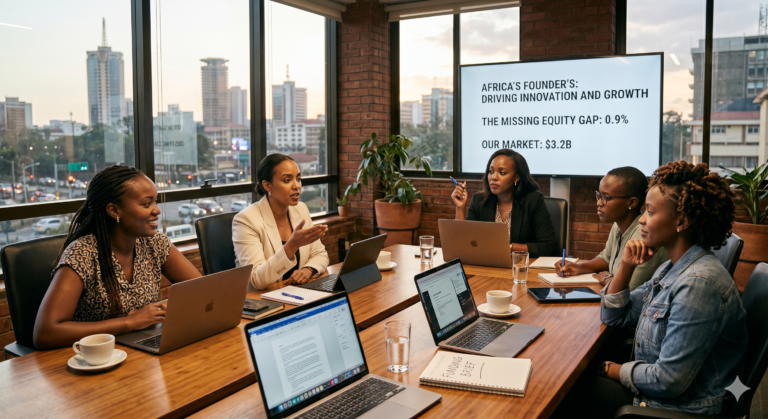
In 2025, female-founded startups across Africa raised just 0.9 percent of the continent’s total $3.2 billion in startup funding. That is the lowest share recorded since 2021.
In Q1 2026, African startups collectively raised $597 million. Women founders and CEOs received $49 million of that. 8.2 percent. That number also represents a 56 percent decline from what women raised in the same period last year.
Let that sit alongside the Swoop story. Aubrey Niederhoffer, 19, no Nigerian ties, $7.3 million in seed funding for an app that has never operated in rain. Standard Chartered Kenya and Strathmore University’s iBizAfrica just graduated their eighth cohort of women in tech, awarding KES 9.1 million in seed funding. Roughly $70,000. Split across an entire group of founders.
That is the comparison nobody wants to make out loud. I am making it.
All-women founding teams secured 20 percent of all grant funding in 2025. Not equity. Grants. Which tells you exactly how investors categorise women-led ventures. Not as businesses. As good causes. There is a difference, and it shows up in the size of the check.
The data also shows something that should embarrass every investor who has passed on a woman-led startup. Women-led startups in Africa are delivering capital-efficient growth, often with 30 to 40 percent lower burn rates than male-led teams. They run tighter. They last longer. They build with less. And they still cannot get the room.
There are women building.
Consolata Mwirichia in Kenya built Innovate AI Health Lab, a multilingual AI chatbot reaching over 20 million Kenyan youth with anonymous, verified sexual and reproductive health information. Jacqueline Okeyo, also from Kenya, built WIKA, an app using AI to help victims of sexual violence report crimes anonymously while connecting them to legal, medical, and therapeutic support. These are not small ideas. These are tools solving problems that male-dominated investor rooms have never had to personally navigate.
They exist. They are building. They are just not on Fortune’s front page.
Women occupy less than 12 percent of leadership positions in African tech companies. In Kenya, women make up only 30 percent of STEM professionals. Those numbers do not reflect lack of ability. They reflect the compounding weight of a system that defaults to funding people who look like the people who already got funded.
I write this as a woman building in this same ecosystem. I know the exhaustion of carrying ideas that the market does not take seriously until someone else validates them. I know what it costs to keep building without the signal that a funding round gives you, not just financially, but in terms of how the world perceives your work.
The women are not missing from this story. The capital is missing from their stories.
That is the distinction that matters.
WHAT DOES ANY OF THIS MEAN FOR YOU?
Two AI worlds are moving fast. A media world is fracturing and rebuilding around trust. A funding world is concentrating at the top and leaving the rest of us to fight over what remains. And within that remainder, women and African founders are getting the smallest slices.
The organisations that will matter in three years are not the ones with the most tools. They are the ones that figured out what actual value looks like for their audience and built toward that with discipline.
For communicators and marketers, the ground has moved. The question is not whether to adapt. It is whether you are honest with your clients about what the data is actually showing.
For builders on this continent, the Swoop and Aubrey story is not an anomaly. It is a preview of what happens when African markets become attractive enough for Western capital to arrive, briefcase first, before local builders have had the chance to raise enough to compete.
For women building in tech and in communications: you are not imagining it. The numbers confirm what you already know. Keep building anyway. Document everything. And find each other.
The two worlds are both moving without us at the centre of the conversation. That is our problem to solve.
Susan Ngatia is a Development Communications Specialist, Pan-African media practitioner, and the founder of Mediatec.Africa and FundingBrief. She writes from Nairobi, Kenya.
Get the Lastest in Communication- Media and the Latest tools
Categorized in:
Subscribe to our email newsletter to get the latest posts delivered right to your email.