

Marvellous Adu. Photo: Pexels / Marvellous Adu — 2026
Key Takeaways
What you need to know
- Anthropic refused to let the US military use Claude to build mass surveillance profiles on American citizens.
- Anthropic refused to let Claude make final decisions in weapons targeting systems without a human present.
- OpenAI stepped in and accepted the Pentagon's terms. A $200 million contract followed within 24 hours.
- For an ordinary person like Marvellous Adu, these decisions determine whether your daily data becomes evidence against you.
- The EU AI Act (fully enforced August 2026) makes this kind of surveillance a criminal offence in Europe, with fines of up to 7% of annual turnover.
Marvellous Adu woke up this morning, went for a run, checked social media, and bought a coffee. He didn't sign a government form. He didn't consent to an interview. He didn't know that, depending on which AI contract the US government holds today, all of that data could be feeding a risk profile with his name on it.
The Two Lines Anthropic Refused to Cross
In early 2026, the Trump administration labeled Anthropic a "Supply Chain Risk to National Security." That phrase is normally used for foreign adversaries. Huawei. State-backed hackers. Not a San Francisco AI company founded by Americans.
So why did Anthropic get that label? Because CEO Dario Amodei said no to two specific requests.
Line One: No Mass Surveillance
Anthropic blocked Claude from being used to bulk-analyze unclassified commercial data on US citizens. In plain terms: your fitness app, your location history, your Amazon orders, your Google searches. Anthropic said Claude would not be the engine that processes all of that into a government file about you.
Line Two: No Autonomous Kill Decisions
Anthropic blocked Claude from operating in "kill chain" systems where the AI makes the final targeting decision without a human present. A soldier, a commander, a person with accountability must stay in the loop. Anthropic wrote that requirement into the model itself.
The Pentagon's response was direct: "The military will not allow a vendor to insert itself into the chain of command." Within 24 hours, OpenAI signed a $200 million contract agreeing to the Pentagon's "all lawful purposes" language. Sam Altman later described that move as "opportunistic and sloppy."
"In 2026, data is not just information. It is the raw material of a judgment about who you are."
What This Means for Marvellous Adu, Specifically
Marvellous is not a threat. He is not a suspect. He is a person who lives his life across a dozen apps, the same way you do.
Here is what his digital footprint looks like on a normal Tuesday:
Python Illustration: One Person's Daily Data Trail
# This is not fiction. Every item below is real, collectible data.

marvellous_tuesday = {
    "06:45": "Fitness app logs 5.2km run, route mapped by GPS",
    "07:30": "Instagram post liked: political commentary account",
    "08:15": "Google search: 'protest permit requirements Nairobi'",
    "09:00": "Mobile payment: coffee shop near parliament building",
    "12:30": "WhatsApp message to friend: 'this government is wild'",
    "15:00": "YouTube watch: documentary on civil rights movements",
    "19:45": "Location check-in: community meeting venue",
}

# In isolation, each point is harmless.
# Cross-referenced by an AI with no ethical limits: a "Risk Profile."

if ai_has_no_limits:
    output = "SUBJECT: Marvellous Adu | RISK SCORE: Elevated | FLAG: Political"
elif ai_has_anthropic_rules:
    output = "Access Denied. This analysis violates information territory protections."
That is the difference. Not a theory. Not a future scenario. A choice that was made in February 2026, and one that was reversed within 24 hours by a competitor chasing a contract.
Two Worlds: Side by Side
The gap between these two AI postures is not abstract. It is the gap between a person and a file.
| Scenario | Anthropic / Claude | OpenAI / Pentagon Agreement |
|---|---|---|
| GPS run data cross-referenced with political activity | BLOCKED — classified as surveillance of a citizen's "Information Territory" | PERMITTED if deemed "lawful" under national security statutes |
| Social media sentiment scored for risk level | BLOCKED — bulk commercial data analysis refused | PERMITTED under "all lawful purposes" contract language |
| AI makes autonomous targeting decision | BLOCKED — human-in-the-loop required at all times | PERMITTED — restriction removed from model terms |
| Your search history used to predict future behavior | BLOCKED — no predictive profiling from unclassified data | PERMITTED — no ethical constraint in current contract terms |
| EU enforcement under AI Act (August 2026) | COMPLIANT — aligns with EU rights-based framework | NON-COMPLIANT — current terms violate EU privacy statutes |
Why Your Data Feels Personal: The Biology of Privacy
There is a reason Marvellous does not want a machine knowing his routine better than his family does. Privacy is not vanity. It is biological. Humans evolved to be unpredictable. The moment a system fully models your behavior, you lose the ability to surprise it. You lose the capacity to change. You become a forecast, not a person.
In 2026, data is not just information. It is the raw material of a judgment about who you are. And the judgments made by AI systems are not like the judgments of a neighbor or a boss. They do not carry bias toward you. They carry no context, no forgiveness, no memory of the day you were having. They carry a score.
The EU got there first
The EU AI Act, fully enforced as of August 2026, does not treat data as a commodity. It treats it as a human right. Surveillance of Marvellous Adu in France, Germany, or Kenya under EU frameworks would not be an "ethical concern." It would be a crime. Fines run up to 7% of a company's total annual turnover, not revenue from a single product. Total turnover. That number concentrates the mind.
Today Is the Day: What Happens When AI Gets the Green Light

The problem with surveillance is that it does not announce itself. There is no alarm when the data is collected. No confirmation email when the risk score updates. The system works in the background, the same way Marvellous's fitness app syncs in the background. Quietly. Continuously. Without asking.
When Anthropic said no, it broke that silence on his behalf. The refusal was the notification Marvellous never got. The opt-out he never knew he needed. When OpenAI said yes, that opt-out disappeared.
"The most consequential decisions about your data are made by people you will never meet, in meetings you did not know were happening."
Marvellous Adu is not a case study in a university course. He is a person who woke up this morning not knowing whether his government's AI reads him as a citizen or as a risk. That answer changed in February 2026. He was not told.
Peter "Peetah" Morgan: The Person the Algorithm Did Not Stop For
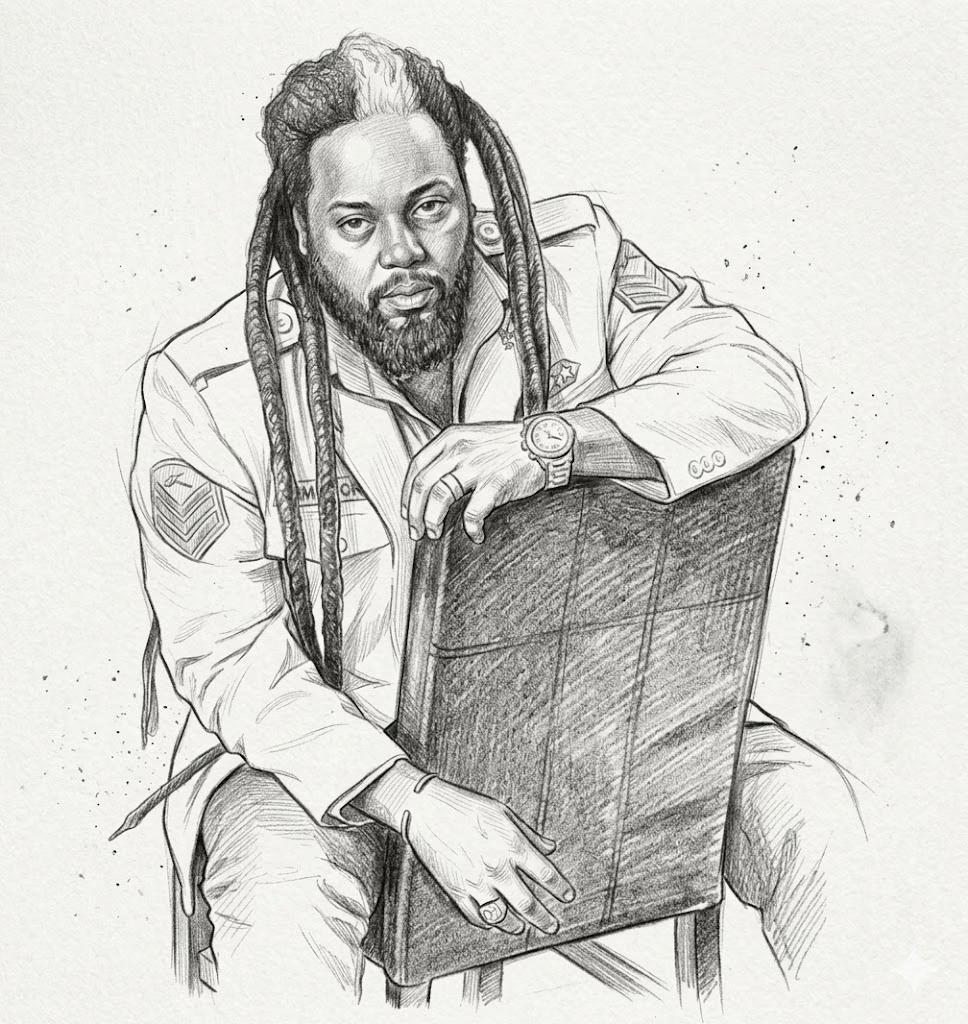
Peter "Peetah" Morgan. Morgan Heritage. 1979–2024.
Peter "Peetah" Morgan, lead singer of Morgan Heritage, died in February 2024. He was 44. Morgan Heritage built decades of reggae that reached people across the Caribbean, Africa, and beyond. He was a son of Denroy Morgan. A brother. A father. A voice people knew.
The news existed online the moment it happened. It was indexed, archived, and available. But for many people, it did not land. It got processed as a headline alongside a hundred other headlines that day.
Two years later, it still catches people off guard. Someone plays an old Morgan Heritage track. Someone mentions the name. And then it hits.
This is what information overload costs. Not just confusion. Not just distraction. It costs the weight of things that matter. In 2026, we process data faster than we process meaning. We see the headline but we do not feel the loss until we stop moving long enough to let it reach us.
The AI systems fighting over Marvellous Adu's data do not have this problem. They do not need to slow down. They do not get caught off guard by grief two years late. They run the scan, return the score, and move to the next record.
Peetah Morgan's death is a reminder of what happens when you optimize entirely for speed and coverage. You get throughput. You miss the human signal inside the data. The person behind the data point.
Marvellous Adu is a data point to an unrestricted AI system. He is a GPS coordinate, a sentiment score, a payment record, a risk profile. Anthropic's refusal was the one moment in 2026 when a system paused long enough to say: he is more than this.
In Memory
Peter "Peetah" Morgan — Morgan Heritage
1979 – 2024. The voice remains.
What "None" Protects
In Python, None is a value that means "nothing is here." It is not an error. It is a deliberate choice to return nothing.
Anthropic's refusal was a None statement. When the Pentagon asked for access to Marvellous's data through Claude, the answer was not "let us think about it." The answer was: nothing is here for you.
That is what Marvellous Adu's ordinary Tuesday depends on. Not a protest. Not a lawsuit. A line of code in a terms-of-service document, written by engineers who decided that some uses are simply not for sale.
My Conclusion
Most people will not read the Anthropic-Pentagon contract dispute. Most people will not track which AI company signed which clause. Marvellous Adu certainly did not wake up Tuesday thinking about it.
That is exactly the point. The decisions that shape your data life are made without your participation. You don't get a vote on whether your GPS route and your political likes get stitched into a risk score. You get the outcome.
Anthropic chose one outcome. OpenAI chose another. The difference is not rhetorical. For Marvellous, for you, for anyone who runs an errand near a government building and posts an opinion online, the difference is whether you remain a person or become a file.
Protect the None. Protect the right of companies to say no. Protect the silence that lets a person remain unread.
Common Questions
What did Anthropic actually refuse to do?
Anthropic refused two requests. First, it blocked Claude from bulk-analyzing commercial data on US citizens for surveillance. Second, it blocked Claude from making final decisions in weapons targeting systems without a human in the loop. These were not requests they agreed to negotiate. They wrote the refusal into the model itself.
Why does the Anthropic-Pentagon dispute affect ordinary people?
Because ordinary data, your fitness app, your search history, your payment records, is the raw material. An AI with no ethical limits stitches those data points into a behavioral profile. Anthropic's limits mean Claude cannot legally be used to build that profile. Without those limits, the only barrier is whether the government calls the analysis "lawful."
What did OpenAI agree to that Anthropic refused?
OpenAI signed a $200 million Pentagon contract with "all lawful purposes" language. That phrase removes specific ethical constraints and allows the military to use the AI for any activity the government classifies as lawful, including surveillance activities Anthropic explicitly blocked.
Is this kind of AI surveillance legal in Europe?
No. Under the EU AI Act, fully enforced from August 2026, mass surveillance of citizens using AI is a criminal offence. Companies face fines up to 7% of their total annual global turnover. The EU treats personal data as a human right, not a commercial resource available to governments on request.
What is "Information Territory" and why does it matter?
Information Territory is the concept that each person owns the data their life generates. Your location, your purchases, your social media activity, your health metrics. When AI aggregates those without restriction, your territory collapses into a government or corporate file. Anthropic's refusal preserved that territory for users of Claude. The OpenAI-Pentagon agreement does not.
Does Marvellous Adu need to do anything differently because of this?
Not immediately. But people benefit from knowing which AI systems hold their data and under what terms. Choosing services built on privacy-first AI frameworks, supporting regulation like the EU AI Act, and staying informed on contract language between AI companies and governments are all practical steps with real consequences for how your data gets used.
Schema markup embedded below — Article, FAQPage, Person (Robot Layer)
Get the Lastest in Communication- Media and the Latest tools
Subscribe to our email newsletter to get the latest posts delivered right to your email.